Eating in Cozumel: The Market, the Food Tour and the Fish You Should Order
Updated September 24, 2026 · 7 min read
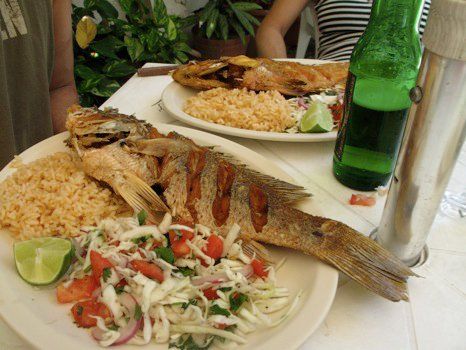
Food is the quietest business on this island. The busiest reef trip here holds 1,476 reviews; the most-reviewed food tour on the island holds 46. That gap says nothing about the food and everything about why people come – and it means eating well here is one of the few things you will arrange yourself.
Two streets inland, and the prices change
Almost everything sold to visitors sits on Avenida Rafael E. Melgar, the seafront road that runs past the three piers, along with the jewellery shops and the tequila shops. It is also where the menus carry dollar prices.
Walk two or three blocks east, away from the water, and you are in an ordinary Mexican town: a plaza, a church, small restaurants with plastic chairs and prices in pesos. San Miguel is small enough that the whole shift takes five minutes on foot, and it is the single most useful thing to know about eating here.
What Yucatecan food actually is
This is Yucatán, not the Mexico of the burrito. The regional kitchen has its own vocabulary, and the dishes worth learning by name before you look at a menu are these:
- Cochinita pibil – pork marinated in sour orange and achiote, slow-cooked until it shreds, served with pickled red onion.
- Sopa de lima – a clear chicken and lime broth with strips of fried tortilla.
- Panuchos and salbutes – fried tortillas, one stuffed with beans and one not, topped with meat, onion and avocado.
- Empanadas, which on this island turn up as a snack rather than a meal.
You will also meet ceviche everywhere: raw fish cured in lime with tomato, onion and coriander. It is the one dish where it is worth asking what the fish is, because the answer is sometimes very local indeed.
The market, and why you go in the morning
The Mercado Municipal on Calle Adolfo Rosado Salas is where the island shops: fish, meat, fruit, chillies, and a row of small kitchens – loncherías, or cocinas económicas – cooking for the people who work around it.
Go early. The market opens with the fish, and the cooked-food stalls follow. Published hours disagree with each other, and the practical version is that this is a breakfast and early-lunch place; by mid-afternoon a good part of it is packing up. A plate here costs a fraction of anything on the seafront, it is cash in pesos, and it is the one corner of Cozumel’s food scene where nobody is performing for visitors.
Pez león – the fish the reef is better without
If you see pez león – lionfish – on a menu, order it.
The species reached the coast of the Yucatán peninsula in 2009 and spread through the reef system, where it has no natural predator and eats the juvenile fish that everything else here depends on. Cozumel’s answer was to fish it and sell it. The island’s fishing cooperative, the Sociedad Cooperativa de Producción Pesquera Cozumel, has organised around that for years, the national park authority has run lionfish fishing tournaments, and divers take it by hand with a spear because a net will not do.
It turns up as ceviche, in croquettes, in burgers and – at the Cervecería Punta Sur, which buys it from local fishermen – on a pizza. The meat is white, firm and mild; the venom is in the spines, not the flesh.
People involved in the effort now describe the population as very substantially reduced, and divers report the fish has become hard to find. Treat that as the island’s own account rather than a survey. What is not in doubt is that this is the rare case where ordering the fish helps the reef.
The food tour: three hours, five stops, someone else paying the bills
The Cozumel food tour runs 3 hours at €79.06 and holds 4.8 stars from 46 reviews.
It is not the only one on sale. Five further food, taco and mezcal walks are listed on this island, and between them they hold four reviews – which is the difference between a tour that actually runs and one that is merely advertised. Check the availability calendar before you fall for a cheaper listing.
What you are buying is not only the food. The itinerary is five stops in a van – local restaurants, a market visit and a bakery, with five to ten minutes of driving between them – at addresses you would have no reason to find on your own, some of them cocinas económicas well away from the water. Food, drinks and transport are included, and the guide settles every bill. It starts and ends at the MEGA supermarket on Avenida Rafael E. Melgar. Special dietary needs can be arranged, but say so when you book, not on the day.
Cooking classes: a market walk, then a kitchen
Two of these exist and they are not the same thing.
The private cooking class in a family kitchen runs 4 hours 30 minutes at €78.18, 4.8 stars from 12 reviews. It starts at the Benito Juárez statue on Adolfo Rosado Salas, walks the market to buy the ingredients, then cooks them in a family home and sits down to eat at the table. Groups are limited to ten, the operator lists it as wheelchair accessible – rare on this island – and it runs rain or shine. A taxi back to the port or your hotel is arranged at the end.
The Maya cooking class is shorter and cheaper: 2 hours 30 minutes at €55.12, 4.6 stars from 13 reviews, with a private instructor and a choice of start times. There is no market walk, and that is the difference worth weighing – half the value of the longer class is the hour spent among the produce.
If it is the cacao workshops you are after rather than a meal, they sit in the culture article with the ruins and the lucha libre.
The part the listings bury: what language it is in
All three of the above are guided in English and Spanish only, and so is the cacao workshop. There is no French, German, Italian or Portuguese guiding in Cozumel’s food offer at all; the listings say so in a line most people scroll past.
For a tour whose entire content is someone explaining what is on the plate, that decides the purchase. If your English is shaky, the market and the restaurants two streets back from Melgar will serve you better than a tasting you can only half follow – pointing works everywhere, and the menus are short.
Water, cash and the bill
Do not drink the tap water. Bottled and purified water is standard in every restaurant on the island, including the cheap ones.
Carry pesos. Dollars are taken along the seafront, and the exchange rate you are given for them is the price of that convenience; away from Melgar, cards are unreliable and small kitchens are cash-only. Tipping is expected, but look at the bill first – some places near the piers add the service themselves, and you can end up paying it twice.
Where this fits in a day
A market breakfast costs an hour, the food tour costs a morning, and the longer cooking class costs most of a day.
If you are off a ship, check the numbers against your all-aboard time before booking the 4.5-hour class – the timings that decide this are in a cruise day in Cozumel. With children, the market and the shorter class work far better than three hours in a van; the rest of that calculation is in Cozumel with children. And if you are still here in the evening, the plaza fills up after the ships leave – that is in Cozumel after dark.
The bookable side of all this is on the food and culture tours page, 51 listings from €18.04, with the rest of what happens on land under things to do, 66 from €10.02.